
Jeffrey Gibson was driving back to his studio last summer after visiting a metal sculpture foundry in upstate New York, with a car full of his studio employees. When a call went to voicemail while he was driving, the caller followed up with a text to his studio manager, also in the car. “Pull over,” he told Gibson. “You need to take this call.” The highly acclaimed artist, of Cherokee descent and a member of the Mississippi Band of Choctaw Indians, discovered he had just made history: he would be the first Indigenous artist to have a solo exhibition at the United States Pavilion of the Venice Biennale. In doing so, he joins a rarefied group of solo exhibitors that includes Jasper Johns and Mark Bradford.
Gibson’s work combines American, Indigenous, and queer histories with influences from fashion and pop culture, often incorporating words, phrases, or lyrics. His Biennale exhibition is titled “the space in which to place me” (referencing the poem “He Sápa” by Oglala Lakota poet Layli Long Soldier) and features 32 works, including sculptures, a video installation, and paintings. “We’re doing a complete transformation of the building and a sculptural installation in the front courtyard,” explains Abigail Winograd, commissioner and curator of this year’s U.S. Pavilion. “It’s going to look like everything you know about Jeffrey Gibson – pattern, color, text, and performance, and works in a variety of media – and I’m hoping it will transform this building into a transformation machine.”
The Biennale: An Epic Art Celebration
Often called the “Olympics of Art,” the Biennale, founded in 1895, is now in its 60th edition, which will run for seven months, with exhibitions and performances big and small throughout the city. There is a Central Pavilion with the main exhibition, which this year will be curated by Adriano Pedrosa, artistic director of the Museu de Arte de São Paulo Assis Chateaubriand in Brazil and the first Latin American to hold this position. In total, 88 countries will be represented. It’s an epic undertaking – because no cars are allowed on the islands of Venice, all the art must be brought in by boat in crates that pass under the area’s many bridges. The opening week of the Biennale typically attracts more than 20,000 collectors, art world heavyweights, and others eager to take part, all converging on islands whose normal year-round population hovers around 50,000. An estimated more than 800,000 people will experience the Biennale over its run this year. The last art Biennale, in 2022, saw fashion brands like Bottega Veneta, Dior (which tapped Jeffrey Gibson to customize a bag last year), Louis Vuitton, and Valentino host events that drew celebrities such as Julianne Moore, Catherine Deneuve, and Maya Hawke.
Venice: A Magnet for Creatives
Despite significant problems of overcrowding due to tourism, the City of Canals remains appealing to creatives. “Everyone wants to come here, for the Biennale but also for Venice,” says Karole Vail, director of the Peggy Guggenheim Collection in Venice and director of the Solomon R. Guggenheim Foundation for Italy. Vail’s grandmother, Peggy Guggenheim, exhibited her art collection, which included Surrealist, Futurist, and Cubist pieces, in the Greek Pavilion at the 1948 Biennale. Shortly thereafter, she acquired an 18th-century palazzo and filled it with her collection; in 1951, she began opening her palazzo to the public. Today, it’s considered a must-see destination.
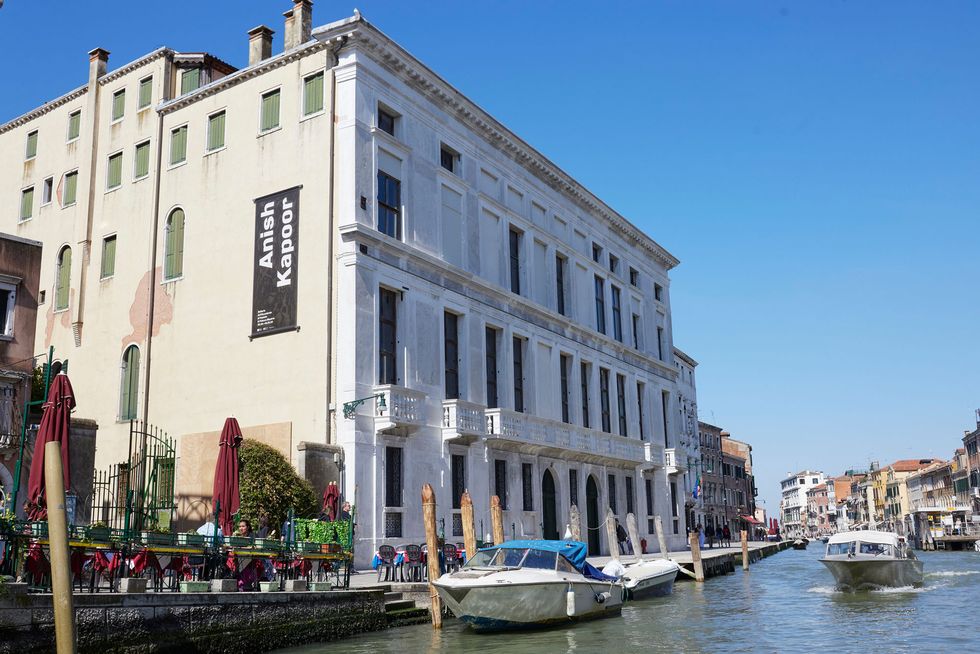
Others have followed her lead, turning Venice into a veritable Mecca of the modern art world. Kering founder François Pinault chose Venice as the only city outside France to publicly display selections from his personal contemporary art collection. The only outpost of Fondazione Prada outside of Milan is an 18th-century palazzo on the Grand Canal. And Anish Kapoor, who represented Great Britain at the 44th Biennale in 1990, now splits his time between London and Venice; he owns an apartment, a studio, and a foundation there.
Venice: A Place for Artistic Creation
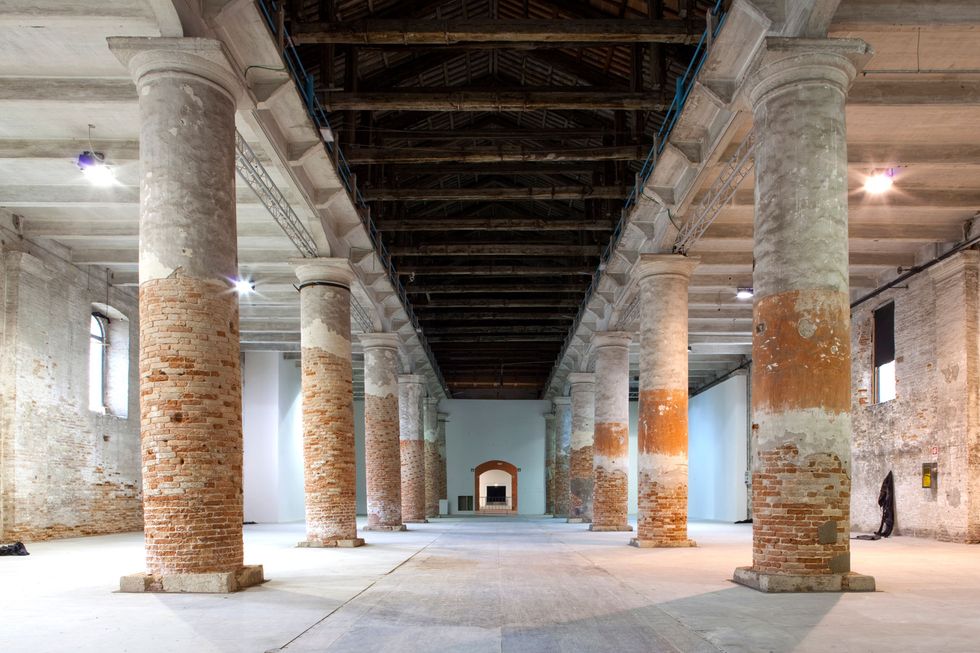
Artist Daniel Spivakov moved his studio to Venice last year. Originally from Ukraine, he was part of a buzz-generating 2023 group show at Palazzo Grassi of the Pinault Collection, and he stayed because, he says, “it’s probably the best city I’ve been in that suits my needs in my art practice. You really have no distractions.” His studio is on Giudecca, Venice’s largest island, a mostly residential area with few tourists that is home to Crea Cantieri del Contemporaneo, an art center that nurtures creatives. Venice keeps Spivakov on his toes. “You don’t get used to being here… there’s an element of surprise,” he says, citing the changing color and height of the water and the lack of greenery. “You don’t really feel the change of seasons here. It can get confusing, as if someone set up this bubble.”
That bubble will undoubtedly burst with the arrival of the Biennale. “It transforms the city into a living organism instead of just a wax museum, by attracting artists like me, who are ready to take part,” says Spivakov. “That’s what brings this city to life.”
